Allahabad HC screening exam Ruling Changes Reservation Rules in UP Recruitment
When preparing for government jobs in Uttar Pradesh, every single mark counts. The latest Allahabad HC screening exam verdict issued by the Lucknow bench on Tuesday establishes that these initial assessments form an integral part of final selections and cannot be dismissed as mere preliminary hurdles.
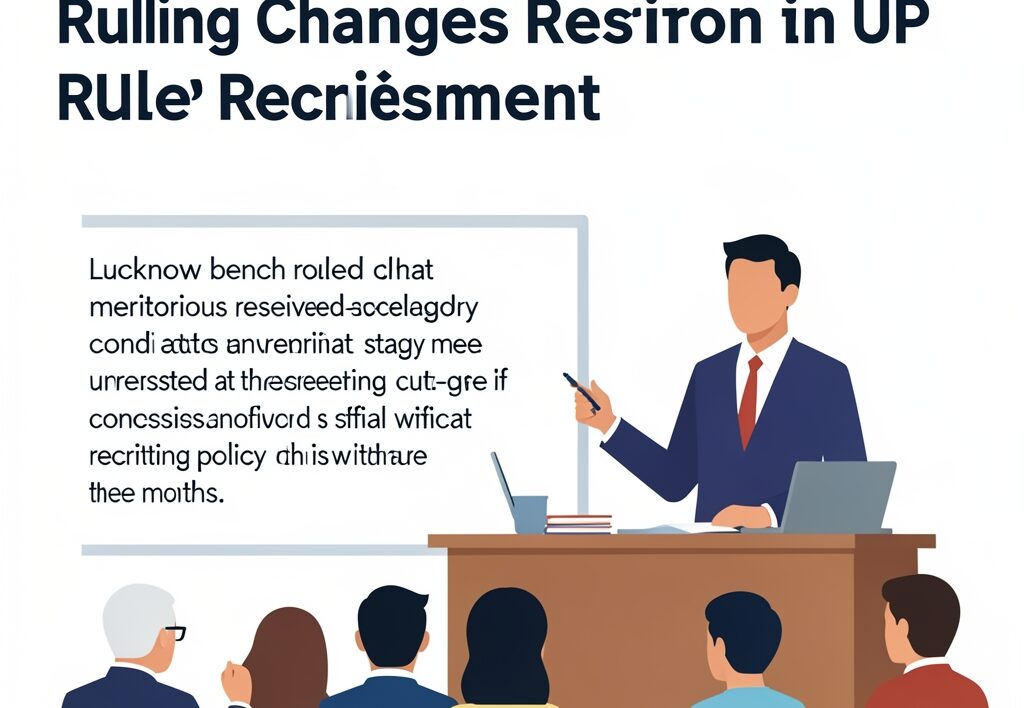
The division bench comprising Justice Rajan Roy and Justice Manjive Shukla delivered this judgment while allowing a special appeal filed by Bhavna Yadav and other petitioners. The court firmly established that meritorious reserved-category candidates must be treated as unreserved applicants right at the screening stage, provided they secure marks above the general category cut-off without taking any relaxation or concession.
For aspirants across Lucknow and neighboring districts who spend years preparing for state examinations, this legal clarification settles a long-standing ambiguity in public recruitment processes, impacting lakhs of youth striving for stability through government service.
Decoding the Court’s Directive on Reserved Categories
Judicial scrutiny often lands on how public recruitment boards balance merit and reservation mandates. In this case, the bench closely examined whether marks scored in initial screening rounds influence the ultimate merit list. The state government now faces a strict three-month deadline to formulate and clarify its policy regarding how reserved candidates scoring high marks are categorized from day one of the recruitment pipeline.
Similar judicial oversight has recently shaped administrative landscapes across the state, such as when the Allahabad HC Lucknow Bench quashed a vigilance probe against IAS officer Abhishek Prakash, highlighting how precise legal interpretations alter administrative trajectories. Aspirants navigating the complexities of state service examinations can also look at other landmark rulings, such as the Allahabad HC SC ST Act ruling on caste disputes, to understand how the judiciary approaches statutory definitions in Uttar Pradesh. Meanwhile, housing and local development disputes face similar scrutiny, mirroring the strict compliance seen under Noida AOA governance rules face strict compliance push under Allahabad HC directives.
- Meritorious reserved candidates scoring above general cut-offs move to the unreserved pool at screening.
- Screening exams carry substantial weight rather than functioning merely as shortlisting hurdles.
- The UP state government must officially codify this policy framework within three months.
Why It Matters for Lucknow Aspirants and the UP Diaspora
Public employment remains a massive aspiration for youth across Lucknow, Kanpur, Prayagraj, and smaller towns throughout Uttar Pradesh. Clear, transparent recruitment rules prevent endless litigation that stalls job placements for years. When recruitment boards alter goalposts or leave screening criteria vague, thousands of candidates find their careers hanging in limbo.
This ruling brings much-needed certainty to aspirants studying in coaching hubs across Aliganj and Hazratganj. Clean governance and recruitment transparency run parallel to other major developments in the state, such as the massive business interest seen at events like the UPITS-2026 Trade Show which clocked ₹6,500 crore in MoUs. Reliable state institutions and predictable recruitment frameworks are essential to sustaining this economic momentum.
Local administration is also receiving broader overhauls, as seen in the Pragati-50 initiative: Lucknow Selected Among Six UP Cities for Major Civic Overhaul, which aims to modernize city infrastructure. Just as urban infrastructure requires robust planning, public recruitment needs absolute clarity so that hardworking candidates are not bogged down by bureaucratic confusion or shifting merit criteria.
As the state government prepares to submit its clarified policy within the mandated three-month window, job seekers and legal experts alike will monitor how recruitment boards restructure their upcoming examination notifications.
Key Takeaway: The Allahabad High Court’s directive forces recruitment agencies in Uttar Pradesh to respect merit at the earliest stage of screening, ensuring that high-scoring reserved-category applicants receive unreserved status immediately.