
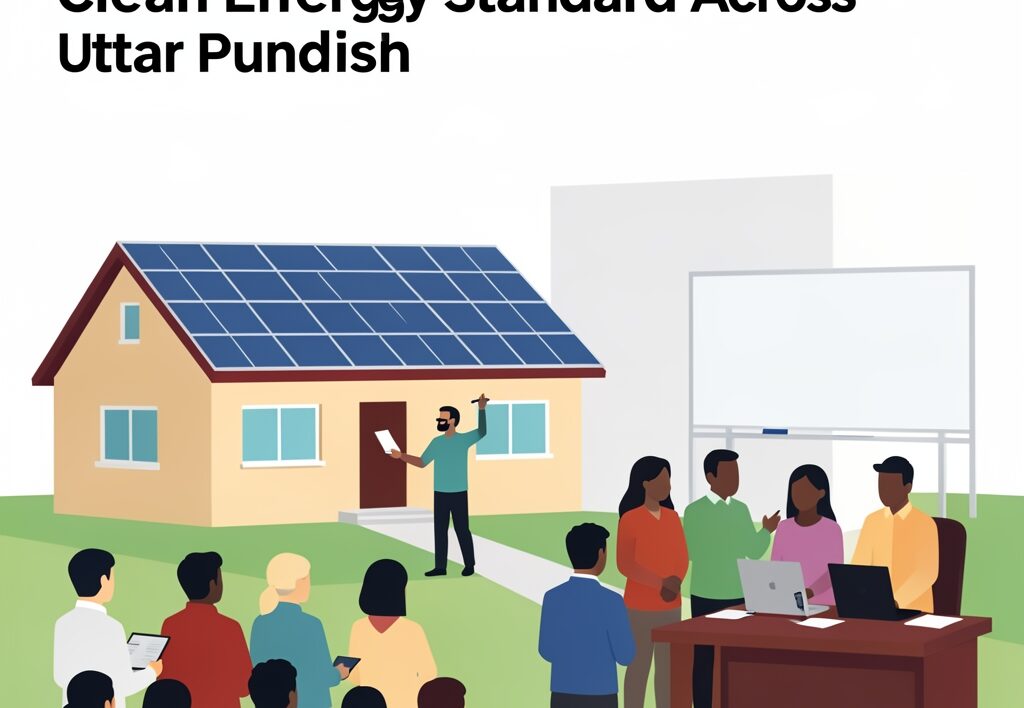
Khargapur Solar Village Project Sets Clean Energy Standard Across Uttar Pradesh
Khargapur solar village initiatives officially took flight this week as authorities confirmed rooftops across the Prayagraj settlement will soon gleam with photovoltaic panels. Situated in the Shringverpur Dham development block of Soraon tehsil, this rural pocket houses roughly 1,100 residents across 210 homes. Out of all development blocks in the entire Prayagraj district, Khargapur stands alone as the solitary selection for this ambitious transition. Driven by the PM Surya Ghar Muft Bijli Yojana, the project aims to transform the local community into an operational blueprint for renewable power generation.
For residents, students, and readers across Uttar Pradesh tracking regional development, the project signals a distinct shift in how rural infrastructure tackles electricity demands. We have seen how severe weather disrupts local grids, as documented during recent Prayagraj rain fury events that left power lines crippled across the region. Moving toward decentralized solar generation reduces reliance on fragile transmission lines and insulates households from sudden grid failures. State planners hope that establishing a functioning micro-grid ecosystem here will prove the viability of clean energy before rolling out similar schemes to neighboring districts.
The Mechanics of Rural Energy Self-Reliance
Under the operational framework, the state aims to build a dedicated solar-powered model village in every single district across Uttar Pradesh. This strategy moves beyond urban centers, targeting rural pockets where power outages traditionally hit agricultural routines and domestic life hardest. By tapping into central subsidy frameworks, families can bypass heavy capital costs while securing long-term electricity autonomy.
The broader regional development picture across Uttar Pradesh also intersects with technological upgrades and modern infrastructure. Students and young professionals watching the state’s growth often look at investments like the Prayagraj NRIPT BTech upgrade to gauge educational momentum, but infrastructural changes at the village level anchor everyday stability. Clean energy adoption directly cuts down household utility expenses while modernizing the domestic landscape. Furthermore, as transport networks expand—such as recent Prayagraj flights expansion initiatives—connectivity in and out of the region continues to accelerate at a rapid pace.
Rural communities face unique energy hurdles that urban grids rarely experience. Long transmission distances mean voltage drops and frequent load shedding during peak summer months. When local transformers blow, repair crews often take days to restore supply because of difficult terrain and poor road access. Solar rooftops bypass these vulnerable transmission miles entirely. By generating power right where it is consumed, families keep their lights on even when the main grid trips. This autonomy changes daily routines for school children who rely on evening study hours and for small shopkeepers running refrigeration units.
Looking Beyond the First Phase and Scaling Up
Execution remains the primary hurdle for state administrators. Converting an entire village requires overcoming initial skepticism regarding rooftop load capacities, maintenance logistics, and grid synchronization. District officials have laid out a phased implementation plan to educate local homeowners on panel upkeep and energy storage.
- Rooftop solar installations covering roughly 210 households in Khargapur.
- Technical integration with local discom infrastructure to manage surplus power feed-in.
- Community training workshops focused on long-term maintenance and panel cleaning.
As state agencies gear up for administrative shifts and political milestones—including ongoing debates surrounding administrative policies like the Akhilesh Yadav Election Commission complaint and high-stakes tours by leaders like Asaduddin Owaisi—grassroots civic projects provide a steady metric of tangible progress. Whether commuters are navigating modernization at the Prayagraj automated driving centre or families are adjusting to shifting political alliances like the Mayawati BSP conditions, the day-to-day push for reliable power remains a universal priority.
Looking ahead, local bodies plan to monitor energy output metrics closely over the next six months. If the pilot proves successful, surplus generation could be fed back into the regional grid, giving participating households an additional source of income through net metering. Local leaders hope this financial incentive will encourage neighboring settlements to adopt rooftop solar without requiring heavy state persuasion.
The ultimate success of the Khargapur model will dictate whether decentralized solar adoption scales successfully across the other 74 districts of Uttar Pradesh.
Why it matters
Energy security directly affects small business output, student study hours, and household budgets across rural Uttar Pradesh. If Khargapur successfully demonstrates total energy self-reliance, the template offers a repeatable formula for thousands of similar settlements facing erratic power supplies.