
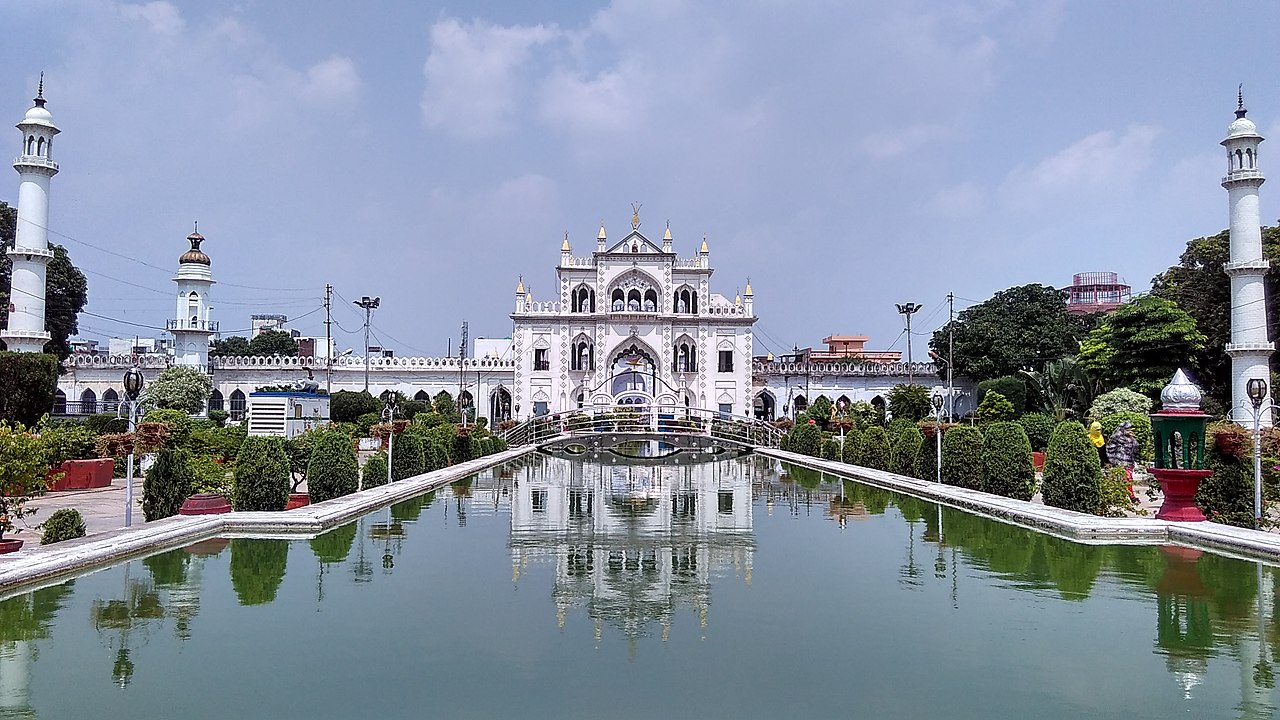
Chota Imambara
A short walk west of Rumi Darwaza, the Hussainabad Imambara still fills with crystal light when the chandeliers are lit. Lucknowis know it as Chota Imambara, the smaller hall, and as the Palace of Lights, the mausoleum Muhammad Ali Shah chose for himself and his mother.
History
Nawab Muhammad Ali Shah, who ruled Awadh from 1837 to 1842, founded this imambara in 1838 as a congregation hall and as his own tomb. His mother is buried beside him. The building is also called Imambara Hussainabad Mubarak. It is Shia in purpose, like the larger hall to the east, but it reads as a jewel box rather than a fortress of brick. European visitors in the nineteenth century nicknamed it the Palace of Lights for the lamps, mirrors, and chandeliers that still define the interior.
Muhammad Ali Shah also set up the Husainabad Trust in 1839, the body that still looks after tickets and upkeep here. He meant Hussainabad to be a planned ceremonial quarter: imambara, mosque, tanks, and a watchtower. Satkhanda, the unfinished tower, belongs to that same programme. It is not a room inside this Imambara. It stands nearby on the Hussainabad ground, meant for seven storeys and stopped at four. Older copy on this site wrongly folded Satkhanda, and even Rumi Darwaza, into the Chota Imambara compound. Rumi Darwaza is a separate sixty-foot city gate, built in Asaf-ud-Daula’s time, west of Bara Imambara. You walk through it to reach this hall. You do not enter this hall through it.
What to see
Approach through the successive gateways on Hussainabad Road. The ceremonial naubat khana, where drums once marked the hours, is the music gallery of this complex, not Rumi Darwaza. A water channel and gardens sit in front of the main facade. Two small white tombs in the garden copy the outline of the Taj Mahal; one holds the grave of the king’s daughter, often named Zeenat-un-Nisa or Zinat Aliyah, and the other was raised as its jawab, a balancing pavilion.
The main building has five doorways, a nod to the Panjetan, the holy five of Shia devotion. Quranic calligraphy in white on a dark ground wraps the exterior. Inside, the Azakhana is the large mourning hall, green and white, hung with Belgian chandeliers and crystal lamp-stands. The Shehnasheen is the raised platform that holds the zarih, a replica of the screen over Imam Husain’s grave at Karbala. Muhammad Ali Shah’s crown, ceremonial tazias in sandalwood, wax, and silver, and a silver mimbar are among the objects still shown. Stucco, gilt-edged mirrors, and calligraphic panels cover the walls. During Muharram the whole interior is meant to blaze.
Give time to the mosque in the compound and to the tank that mirrors the gilded dome. Then step back outside the ticketed court for Satkhanda, the Hussainabad Clock Tower, and the Picture Gallery in the old baradari, where oil portraits of the Nawabs hang in a long, cool hall. Those last two are neighbours, not rooms of this Imambara.
Visiting
The Husainabad and Allied Trust sells a combined pass that typically covers Bara Imambara, Chota Imambara, Satkhanda, and the Picture Gallery. In August 2026 the Trust listed a Chota Imambara-only Indian adult pass at Rs 20, and the combined pass at Rs 60. Hours on that portal were 6 am to 6 pm. Friday prayer times can shorten access; Bara Imambara is separately listed as closed from 10 am to 3 pm on Fridays. Confirm both the rate and the day’s hours at the counter. Footwear comes off in the prayer spaces. Dress as you would for a mosque.
Hussainabad sits in the old city, west of Hazratganj and a few kilometres from Charbagh. Autos from Kaiserbagh, Chowk, and Hazratganj Metro are the usual last hop; the Red Line does not yet serve the Imambara gates. Pair this visit with Bara Imambara on the same morning so you are not buying two stories of the same ticket. After you come out, Chowk is close for kebabs and sheermal. Winter light is kinder on the calligraphy and the chandeliers.
Nearby
Rumi Darwaza stands between this hall and Bara Imambara. The Clock Tower and Satkhanda share the same open ground. If you still have an afternoon, the British Residency in Qaiserbagh is a short ride and a change of register: ruins instead of gilt. More of the city’s map is gathered under Lucknow places.
A note on etiquette
Chota Imambara is a tomb and a working azakhana. Keep voices down around the graves. Do not touch the chandeliers, tazias, or the zarih. During Muharram, follow the marshals and do not treat mourning as a spectacle. Photography rules are posted at the gate and can tighten on holy days.
\n\n
FAQs
What is Chota Imambara and why visit?
A short walk west of Rumi Darwaza, the Hussainabad Imambara still fills with crystal light when the chandeliers are lit.
What can visitors do there?
Approach through the successive gateways on Hussainabad Road.
What are the timings or entry arrangements?
The Husainabad and Allied Trust sells a combined pass that typically covers Bara Imambara, Chota Imambara, Satkhanda, and the Picture Gallery.
How do I reach it and what should I know before going?
Hussainabad sits in the old city, west of Hazratganj and a few kilometres from Charbagh.
How long should I spend and what can I pair nearby?
Rumi Darwaza stands between this hall and Bara Imambara.