
Rumi Darwaza
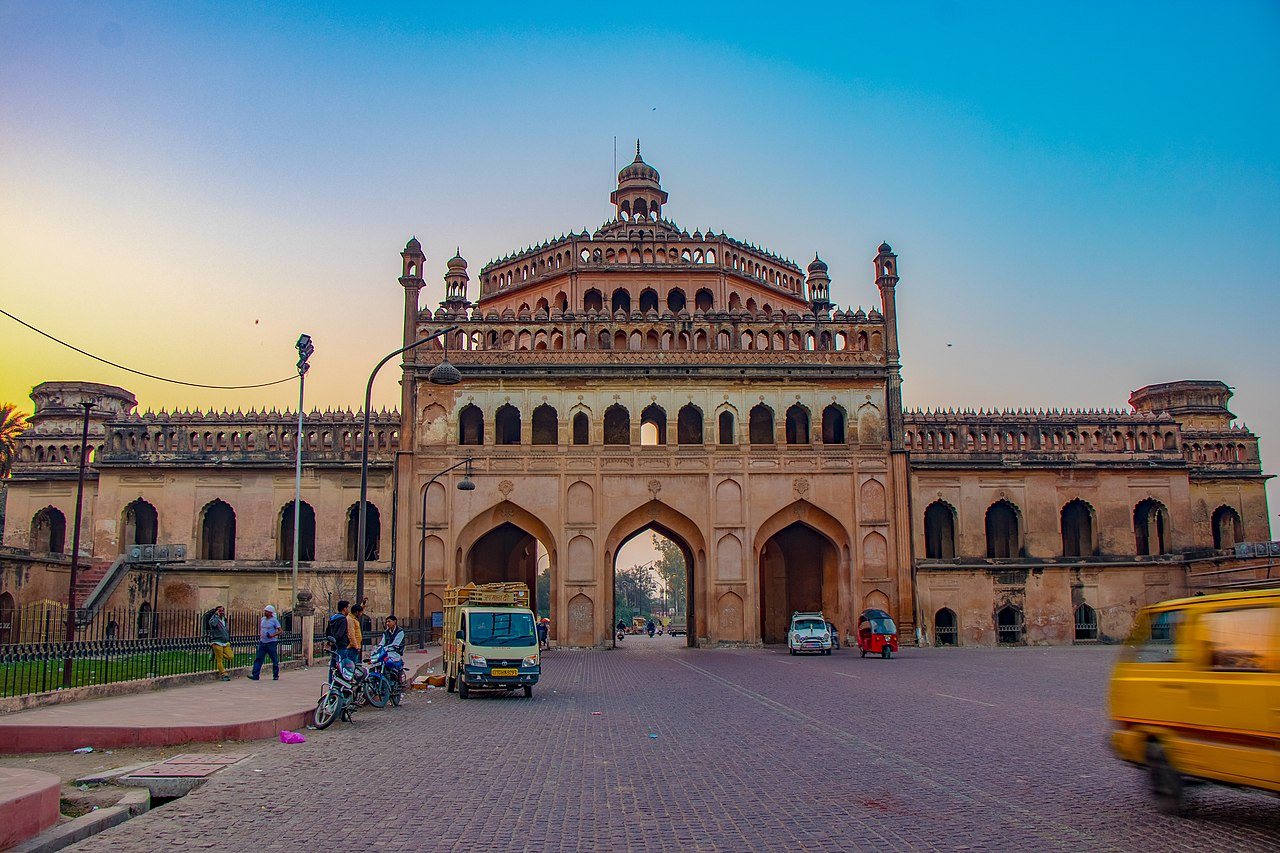
Between the two Imambaras, traffic still threads a sixty-foot brick arch that once marked the way into old Lucknow. Rumi Darwaza is not a ticketed hall and not the doorway of either Imambara; it is a city gate, raised in the same famine years as the great hall to its east, and Lucknow still uses it as a road.
History
Nawab Asaf-ud-Daula built this gateway around 1784 as part of the same public-work programme that produced Bara Imambara. Famine had emptied purses; bricklaying put wages in hands. The gate was modelled on the Sublime Porte, the Bab-i Humayun of Ottoman Istanbul, which is why Lucknow also calls it the Turkish Gate. “Rumi” here points to Rum, the old name for the lands of Anatolia and the eastern Roman world, not to the poet Rumi.
It stood as the ceremonial western entrance toward the old city and the palaces that once lay beyond. After 1857 the British demolished much of that palace quarter. The arch remained, a free-standing screen on the road that now links Bara Imambara to Chota Imambara. That geography matters. Rumi Darwaza is west of the Asafi Imambara. It is not the Imambara’s own entrance, which is a separate pair of tri-arched gateways inside the paid complex. It is also not a ceremonial gate of Chota Imambara; that hall has its own naubat khana. Earlier pages on this site mixed those three doors. They are three different structures.
What to see
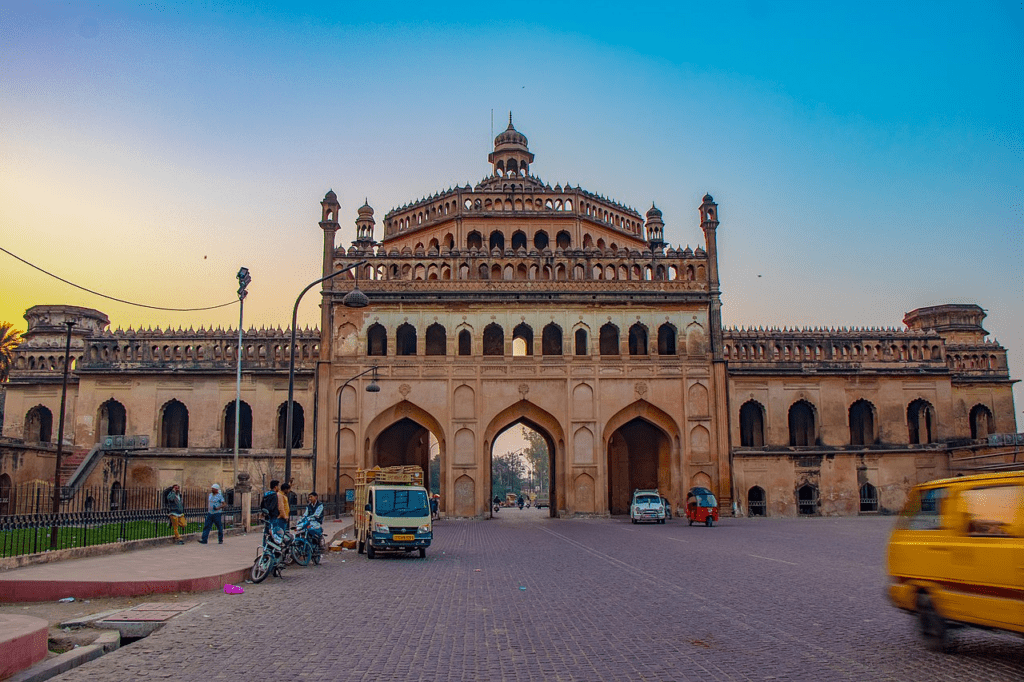
Image Source
Stand far enough back to read the full height: about sixty feet of lakhauri brick coated in lime plaster, carved with floral work that lime made possible. Mughal red sandstone is not the language here. Awadhi builders preferred brick and chunam, which takes a finer cut. The great arch is flanked by smaller openings. An octagonal chhatri, like a small umbrella, sits on the crown. Older accounts speak of a lantern up there and of water once jetting from the facade. The stair to the top is not a public climb today. Look, do not scale it.
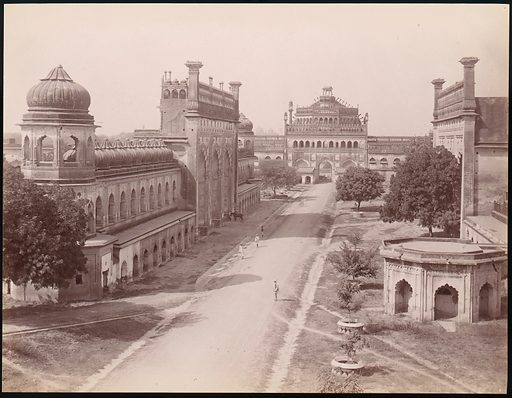
From the east face you see Bara Imambara’s walls and, if you angle right, the Imambara’s own gateway and its jawab. Nineteenth-century photographs still show that pairing clearly. From the west face the road runs on toward Hussainabad, the Hussainabad Clock Tower, Satkhanda, and Chota Imambara. Teele Wali Masjid sits close by. The gate is at its best after dusk, when the plaster takes the floodlights, and in the first hour after sunrise, when the road is quieter and the carving is readable.
Visiting
There is no ticket for Rumi Darwaza. It sits on a public road in Hussainabad. You can walk up to it, through it, or around it at any hour, though late night is a traffic corridor, not a promenade. The paid monuments on either side keep their own hours and counters. Do not buy a “Rumi Darwaza ticket” from anyone on the pavement.
Reach it the same way you reach the Imambaras: auto from Hazratganj, Kaiserbagh, or Charbagh; Metro to Hazratganj or KD Singh Babu Stadium, then a last hop. The stretch between the two Imambaras is walkable and is the right way to understand the gate, as a hinge rather than a destination with a ticket window. Watch for buses and e-rickshaws under the arch. Chowk’s kebab shops are a few minutes south and west. Photographers crowd the west face at sunset; the east face, looking back at Bara Imambara, is quieter in the morning. If you are collecting a Trust combined pass, buy it at Bara Imambara or Chota Imambara, then use the road under this arch as the walk between them.
Nearby
Bara Imambara is immediately east; Chota Imambara, the Clock Tower, Satkhanda, and the Picture Gallery lie west along the same axis. The British Residency is a short ride toward Qaiserbagh if you want the 1857 ruins after Nawabi brick. More stops are listed among Lucknow places.
A note on care
The plaster is old and the arch takes a beating from traffic fumes. Do not climb the facade or scratch names into the lime. Keep the carriageway clear. The gate is a working street as much as a monument, which is part of why Lucknow is fond of it.
\n\n
FAQs
What is Rumi Darwaza and why visit?
Between the two Imambaras, traffic still threads a sixty-foot brick arch that once marked the way into old Lucknow.
What can visitors do there?
Stand far enough back to read the full height: about sixty feet of lakhauri brick coated in lime plaster, carved with floral work that lime made possible.
What are the timings or entry arrangements?
There is no ticket for Rumi Darwaza.
How do I reach it and what should I know before going?
Reach it the same way you reach the Imambaras: auto from Hazratganj, Kaiserbagh, or Charbagh; Metro to Hazratganj or KD Singh Babu Stadium, then a last hop.
How long should I spend and what can I pair nearby?
Bara Imambara is immediately east; Chota Imambara, the Clock Tower, Satkhanda, and the Picture Gallery lie west along the same axis.