
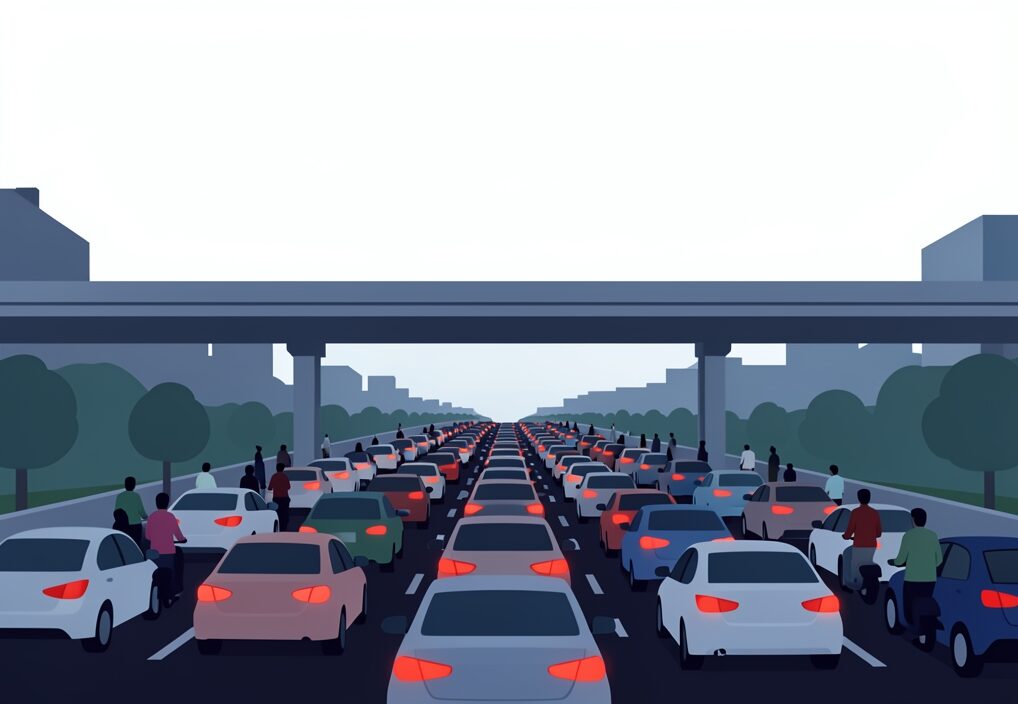
Lucknow Traffic Gridlock: Shaheed Path Chokes Ahead of PM Modi Visit
Lucknow traffic gridlock returned with a severe impact on Saturday evening, bringing major arterial roads across the capital to a complete standstill. Commuters heading home or navigating through the city found themselves trapped in agonizing delays as vehicles piled up along Shaheed Path and connecting corridors. The sudden paralysis gripped the city just hours before a high-profile official itinerary brought strict security cordons and elaborate diversions to east Lucknow, altering daily transit for thousands of residents.
The core of the congestion centered around routes leading to the Indira Gandhi Pratishthan (IGP) in Gomti Nagar. Thousands of students, dignitaries, and attendees made their way to the venue for the fifth Kaushal Dikshant Samaroh, creating an unprecedented volume of vehicular movement. Motorists trapped near underpasses and major intersections reported crawling at a snail’s pace, spending upwards of thirty minutes to clear a single kilometre of road space while emergency services and local buses struggled to find clear passage.
The Anatomy of a Citywide Bottleneck
Traffic management ahead of high-level VVIP movements repeatedly tests the resilience of urban infrastructure in Uttar Pradesh. In this instance, the friction points were concentrated across a vast corridor stretching from Amausi Airport through Shaheed Path into Gomti Nagar. Despite prior warnings issued by local law enforcement, commuters found standard shortcuts blocked or heavily restricted by security protocols.
This situation mirrors recurring administrative challenges seen during major public gatherings across the state capital. Similar systemic strains have been highlighted in discussions regarding Lucknow school traffic chaos and past Lucknow traffic gridlock festive rush incidents. Urban planners point out that whenever expressways carrying heavy regional traffic are locked down for official events, the shockwaves instantly spill over into residential lanes.
Ahead of the event, the traffic department attempted to cushion the blow for local residents. DCP traffic Anil Kr Yadav released a video appeal urging motorists to avoid Shaheed Path between 4 pm and 8 pm unless travel was absolutely unavoidable. Authorities mobilized approximately 2,300 traffic personnel across the city to regulate the massive influx of attendees heading to the convocation ceremony. Brief halts were also implemented along key paths to accommodate the Prime Minister’s motorcade, aligning closely with security protocols detailed during the PM Modi Lucknow visit tightens security updates.
Furthermore, civic analysts note that while major convocations such as the National Skills Convocation in Lucknow Set to Draw PM Modi on Nov 21 bring immense educational prestige to the city, they routinely expose vulnerabilities in our micro-diversion planning. When combined with other urban pressures like Lucknow groundwater extraction exceeds safe limits by 28 percent or seasonal municipal challenges such as Lucknow Municipal Corporation Fixes Ghat Lighting and Safety Ahead of Chhath Puja, it becomes clear that infrastructure management requires continuous multi-departmental oversight.
Impact on Daily Life and Urban Mobility
For ordinary residents, the gridlock highlights the persistent vulnerability of Lucknow’s major ring roads when subjected to simultaneous heavy events. While high-profile national visits bring development focus to Uttar Pradesh, they test the daily patience of commuters relying on arterial expressways for essential travel.
Here is what residents experienced on the ground during Saturday’s gridlock:
- Traffic movement slowed to a complete crawl across Shaheed Path and surrounding feeder roads.
- Several key underpasses witnessed absolute vehicle lockups during peak evening transit hours.
- Alternative routes suggested by police also filled up rapidly as diverted vehicles sought passage.
- Public transport users and auto-rickshaws faced severe fare spikes and extended travel times.
The takeaway for daily commuters is clear: rapid urban expansion requires more resilient micro-diversion strategies that protect local arterial flow during national events without isolating entire neighborhoods.
Why it matters
As Lucknow rapidly expands as an economic, residential, and educational hub, balancing high-profile state visits with seamless daily transit remains a defining civic test. When critical bypasses like Shaheed Path choke, the disruption cascades into residential sectors, affecting emergency medical services, students, and office workers alike. City planners must evaluate whether existing alternative road networks can absorb sudden shifts in traffic volume without triggering widespread gridlock every time a national dignitary visits the capital.