Congress Protests Uttar Pradesh Target Chief Election Commissioner’s Residence
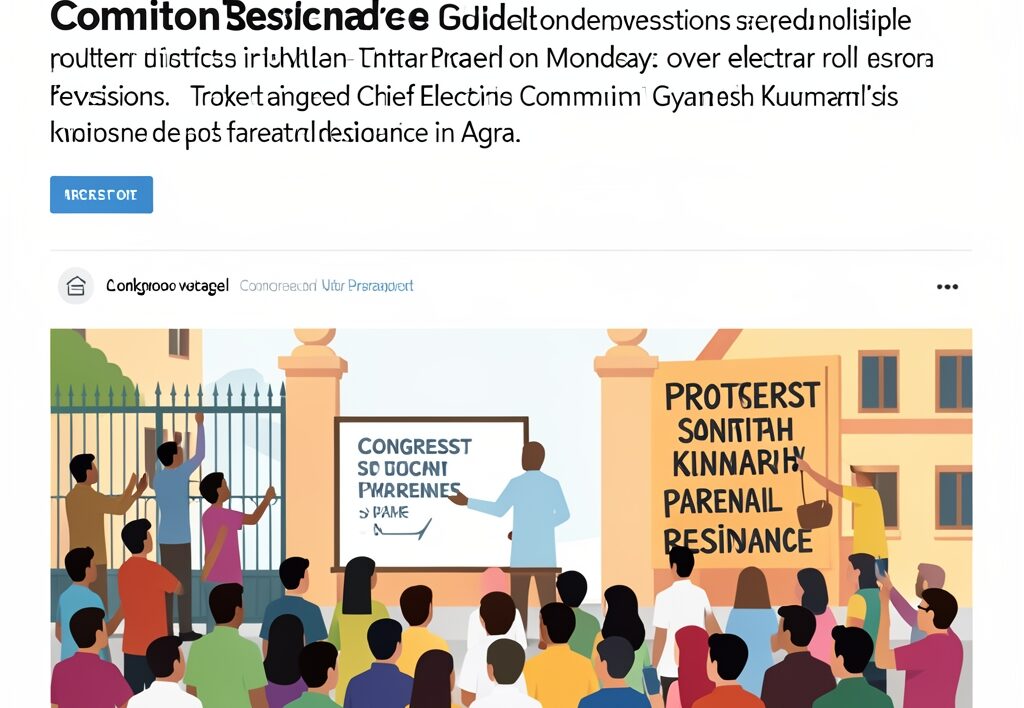
Congress protests Uttar Pradesh style escalated sharply on Monday as party workers staged demonstrations across multiple districts and targeted the parental residence of Chief Election Commissioner Gyanesh Kumar in Agra. The political friction centers on mounting controversies over the Election Commission’s functioning and the Special Intensive Revision of electoral rolls. While agitation unfolded on urban streets, the ripple effects are being closely monitored by residents and political observers across the state.
The demonstration at Kumar’s family home in Agra’s Vijay Nagar Colony saw protesters painting slogans directly onto the main entry gate. Local law enforcement personnel responded swiftly to clear the markings and manage the crowds gathered under the Hariparvat police station limits. Although no family members were inside the premises at the time—only a private guard and first-floor tenants—the optics of targeting a residential address drew immediate institutional condemnation and swift police action.
Arrests and Statewide Agitation
Police confirmed the detention of prominent figures leading the charge. Former Congress state general secretary for organization Anil Yadav and Mathura district Congress president Mukesh Dhangar were arrested in Agra. Parallel protests erupted in several other districts throughout Uttar Pradesh, signaling a coordinated state-level push by the opposition party against the poll panel’s administrative processes. For citizens tracking regional developments, such unrest evokes memories of past security challenges, much like the investigations seen when an Agra arms smuggler arrested in Haryana highlighted interstate crime networks operating across the region.
For citizens tracking regional developments from university campuses to commercial hubs, these flare-ups reflect a deeply polarized political landscape. Similar high-stakes demonstrations have tested local law enforcement before, drawing parallels to recent campus tensions seen during incidents like the Noida Student Protest Notice. Public demonstrations often disrupt normal daily routines and prompt heavier police deployments across major urban centers, echoing the public anxiety witnessed after incidents such as the Agra road robbery where a trader was robbed of ₹40 lakh cash in broad daylight.
Broader Implications for State Politics
Electoral roll revisions rarely trigger direct residential confrontations, making Monday’s events an escalation in street-level tactics. Political analysts note that aggressive opposition tactics often precede major electoral battles, mirroring strategic momentum shifts seen during intense regional campaigns such as the AIMIM Campaign Uttar Pradesh trail. State authorities remain on high alert as opposition parties continue to challenge administrative bodies on procedural transparency, a theme that consistently dominates public discourse alongside debates surrounding the Uniform Civil Code Uttar Pradesh poll push.
Law enforcement agencies are increasingly turning to technology to manage public order and maintain surveillance during volatile political seasons. Recent modernization efforts, highlighted by the launch of the Agra police PRAGYA AI data centre, show how regional authorities aim to handle security challenges more effectively. Meanwhile, economic milestones like the Uttar Pradesh International Trade Show deals remind citizens of the state’s commercial ambitions running parallel to its political turbulence.
- Protesters painted slogans on the main gate of CEC Gyanesh Kumar’s parental home in Agra.
- Key opposition figures Anil Yadav and Mukesh Dhangar were taken into custody by local police.
- Demonstrations concurrently spread to multiple districts across Uttar Pradesh.
Political friction on urban streets directly impacts commuter movement, local security protocols, and civic discourse across Uttar Pradesh.
Why it matters
For residents and the broader diaspora keeping an eye on home affairs, street protests involving constitutional authorities point to a hardening political climate. When administrative bodies become focal points for direct action at private residences, local security apparatuses respond with heightened surveillance and stricter crowd control measures. Understanding these dynamics helps residents anticipate traffic diversions, heavy police barricading, and potential civic disruptions during politically charged seasons.