
Hussainabad Clock Tower
On the Hussainabad maidan a Victorian Gothic tower rises well above the Nawabi skyline, and the city still glances up when the bells sound. Ghantaghar is a Trust-built clock, not a Nawab’s palace. You look at it from the road; you do not go inside.
History
The Hussainabad Clock Tower was completed in 1881, decades after Awadh had passed into British hands. It was not commissioned by Nawab Nasir-ud-Din Haider, who died in 1837. The money came from the Husainabad Endowment, the fortune Muhammad Ali Shah left in 1839, spent by the Trustees of that endowment. District records credit architect Richard Roskell Bayne. The tower was raised to mark the arrival of Sir George Couper, the lieutenant-governor. Period accounts put the cost near two lakh rupees. Older tourist pages, including an earlier version of this one, also credited Bayne with Chattar Manzil. That palace is a different story, Nawabi and riverside, and Bayne did not design it.
A contemporary description, still quoted by Lucknow guides, says the Trustees erected a tower 221 feet high and 20 feet square from Bayne’s design, to hold a clock of great size made by J.W. Benson of Ludgate Hill, London. Gunmetal wheels, wrought-iron sides, and hardened steel pinions were the boast of the mechanism. The district gazetteer style of writing compared the wheels favourably with those of London’s great clock. Height figures in official notes run about 221 feet, or 67 metres, which is why Lucknow still calls this the tallest clock tower in the country.
Source: Wikimedia Commons

What to see
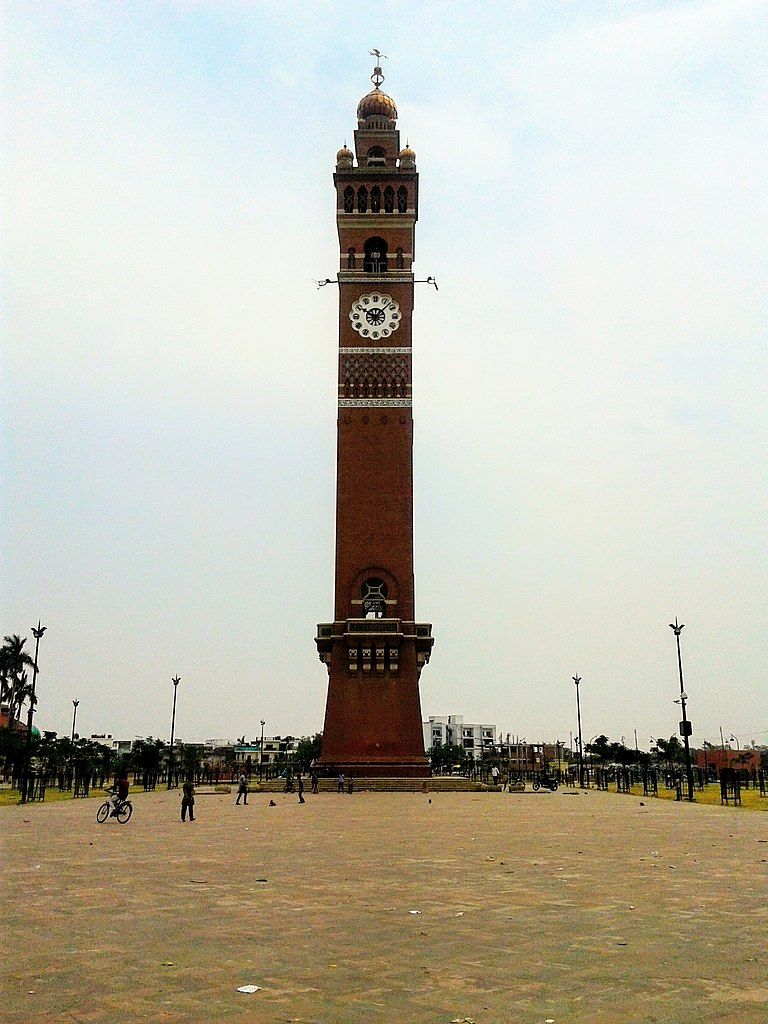
Walk the maidan, not a staircase. Public access to the interior and the clock chamber is closed. What you come for is the silhouette: red brick and stone, Gothic openings, a floral clock face, and the way the tower sits among older neighbours. It stands close to Rumi Darwaza, Chota Imambara, Satkhanda, and the Hussainabad Picture Gallery in the old baradari. Satkhanda, the unfinished four-storey watchtower, is a separate brick pile from Muhammad Ali Shah’s own reign. Do not confuse the Victorian clock with that Nawabi tower.
The clock has stopped and been repaired more than once. Enthusiasts fought off a plan, around 2010, to replace the old movement with an electronic substitute; mechanical work brought the chime back. Whether it is keeping time on the morning you visit is a matter of maintenance, not a promise. Listen. If the bells are quiet, the tower is still worth the photograph. Evening floodlights pick out the brick. The Picture Gallery next door, often on the same Trust combined pass as the Imambaras, holds portraits of the Nawabs and is the indoor half of this stop.
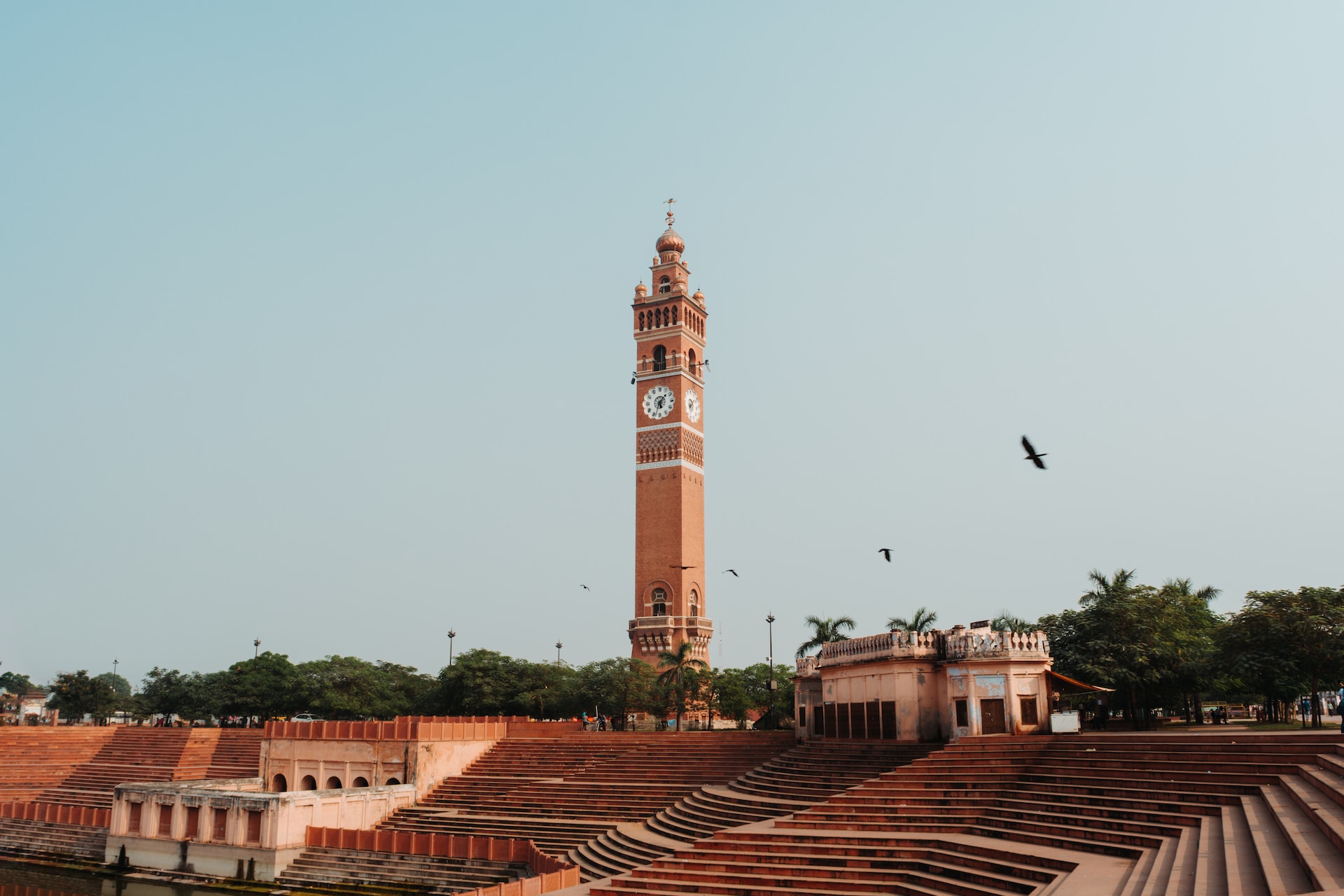
Photo by Abdullah Ahmad on Unsplash
Visiting
The tower itself has no ticket and no opening hour. It is a street monument on the Hussainabad ground. You can stand before it whenever the maidan is safe to walk. Neighbouring halls do charge. The Husainabad and Allied Trust listed, in August 2026, a combined pass for Bara Imambara, Chota Imambara, Satkhanda, and the Picture Gallery, with hours given as 6 am to 6 pm. Confirm those rates and hours at the Trust counter. Do not pay anyone for a “clock tower climb.” There is no public climb.
Reach Hussainabad by auto from Hazratganj, Kaiserbagh, Chowk, or Charbagh. Metro riders alight at Hazratganj or KD Singh Babu Stadium and continue by e-rickshaw. Pair the tower with Bara Imambara and Chota Imambara on the same loop. Give the maidan ten quiet minutes: the tower is easy to under-see if you only shoot it from a moving auto. Chowk is close enough for kebabs after the photographs. Winter evenings are the usual local hour for a slow walk here, when the lights are on and the old-city heat has dropped.
Nearby
Rumi Darwaza, the two Imambaras, Satkhanda, Teele Wali Masjid, and the Picture Gallery make this the densest heritage stretch in the old city. Spend time in the baradari if it is open; the Nawabi portraits explain who paid for the endowment that later paid for this tower. The British Residency is the next historical register if you ride toward Qaiserbagh, a reminder that this clock went up in a Lucknow already under the United Provinces, not under a sitting Nawab. For a wider list, see Lucknow places.
\n\n
FAQs
What is Hussainabad Clock Tower and why visit?
On the Hussainabad maidan a Victorian Gothic tower rises well above the Nawabi skyline, and the city still glances up when the bells sound.
What can visitors do there?
Walk the maidan, not a staircase. Public access to the interior and the clock chamber is closed.
What are the timings or entry arrangements?
The tower itself has no ticket and no opening hour.
How do I reach it and what should I know before going?
Reach Hussainabad by auto from Hazratganj, Kaiserbagh, Chowk, or Charbagh.
How long should I spend and what can I pair nearby?
Rumi Darwaza, the two Imambaras, Satkhanda, Teele Wali Masjid, and the Picture Gallery make this the densest heritage stretch in the old city.