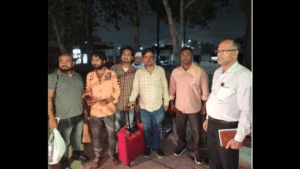

IIT Kharagpur Team Set to Submit Report on Lucknow-Kanpur Expressway Failures Amid Design and Drainage Concerns
The much-awaited report from the Indian Institute of Technology Kharagpur on the recurring structural failures along the Lucknow-Kanpur Expressway is expected within a week, according to highly placed sources familiar with the investigation. Preliminary observations by the two-member expert team have indicated possible deficiencies in the road design and drainage systems rather than solely construction quality issues.
The six-lane expressway, constructed at a cost of approximately Rs 4,200 crore and opened to traffic in mid-July, has faced multiple instances of road subsidence, cracking, depressions and surface slippage within weeks of inauguration. Water seepage has been observed on the shoulders at several locations, with reports of water penetrating as deep as 18 feet in some stretches, potentially compromising the pavement strength.
A major slippage occurred near kilometre 64 in Unnao district on July 26, prompting the National Highways Authority of India to launch a detailed probe. The IIT team collected around 50 samples from various locations for laboratory and forensic analysis. Officials noted that the investigation is examining the movement of water through and around the pavement structure, alongside factors such as soil conditions, embankment compaction and pavement-layer specifications.
NHAI Chief General Manager and Regional Officer for Uttar Pradesh, Gautam Vishal, stated that the findings would be particularly important in determining the root causes. The authority has already issued a non-performer notice to the concessionaire, PNC Infratech, ordered reconstruction of damaged portions at the contractor cost, suspended toll collection on affected stretches and initiated proceedings against the independent engineer and supervising officials.
Between the opening and early August, depressions or patchwork failures were reported at around 45 locations along the 45-kilometre greenfield section. While many have been repaired, fresh concerns including a crack in a crash barrier on a bridge and further subsidence continue to surface. Travel time claims of around 40 minutes between the two cities have been impacted by ongoing repair works.
The developments come amid broader questions on infrastructure durability in the state, similar to recent debates triggered by waterlogging at the newly operational Noida International Airport. Residents and experts have called for thorough scrutiny of design standards and quality control in major highway projects, especially given the monsoon season.
Related coverage of monsoon-related infrastructure challenges can be found in reports on roof collapse incidents highlighting safety concerns across Uttar Pradesh and the Noida Airport waterlogging that sparked fresh debates on project readiness.
The final IIT report is expected to clarify whether the failures stem from design flaws, inadequate drainage, soil treatment issues, material quality or a combination of factors. Its conclusions will guide decisions on whether localised repairs suffice or if more fundamental engineering interventions are required to ensure long-term safety and reliability of the corridor.