
Sanjay Nishad Protest in Lucknow Clarifies Alliance Stand Ahead of 2027 Polls
Sanjay Nishad Protest in Lucknow Clarifies Alliance Stand Ahead of 2027 Polls
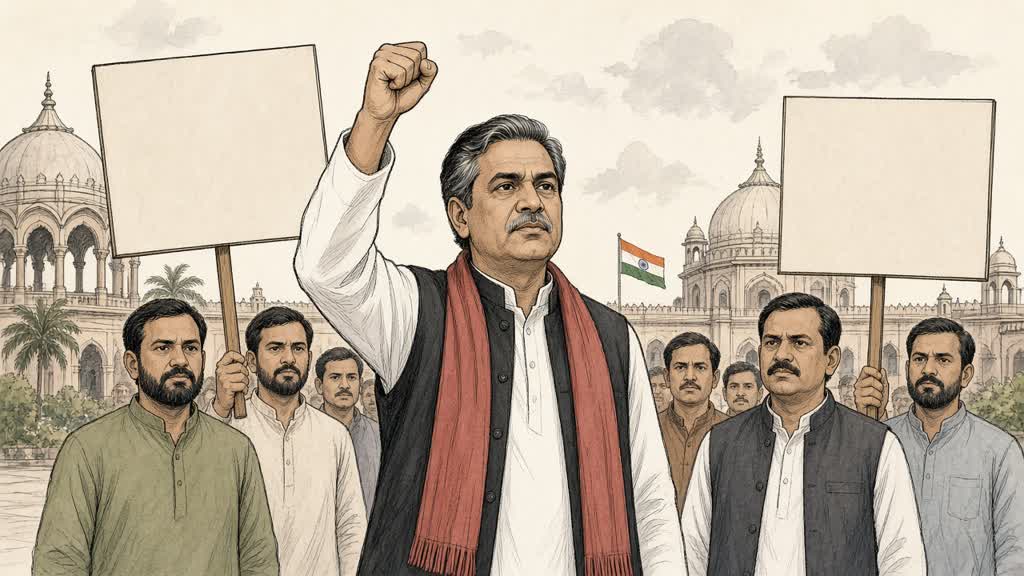
Uttar Pradesh fisheries minister Sanjay Nishad protest actions in Lucknow and Gonda on Friday sparked intense political chatter across state corridors, prompting the Nishad Party chief to publicly clarify that his demonstrations do not signal a fallout with the ruling BJP administration. Speaking to reporters after staging a high-profile sit-in at King George’s Medical University (KGMU), Nishad insisted that his actions solely target justice for the murder of 45-year-old Gonda utensils trader Vinod Kumar Sahni, while reaffirming his commitment to the current coalition ahead of the 2027 state elections.
The political climate in Lucknow has remained hyper-sensitive as parties gear up for major electoral battles. Rumors had swirled regarding potential realignments, particularly with speculation pointing toward possible talks with the opposition. However, Nishad cut through the noise with characteristic bluntness. He noted that being part of the government enabled his party to secure an official murder case registration, arguing that working from within the system remains the most effective path to uplift his community.
Decoding the Political Balancing Act
For residents and political watchers keeping an eye on capital developments, balancing grassroots community advocacy with ministerial responsibilities is a delicate tightrope walk. When regional satraps step out onto the streets to protest crimes against their constituents, it often creates friction within coalition frameworks. Yet, Nishad’s quick containment of the narrative shows a pragmatic approach.
Political calculations in Uttar Pradesh frequently stretch beyond simple seat-sharing arrangements. Leaders must constantly prove their street-level credibility to their base while maintaining functional harmony with major state partners. As security protocols tighten across party lines—evidenced by recent measures like UP Elections 2027 bullet-proof jackets issued to top leaders—political survival requires a careful mix of aggressive public posturing and quiet administrative coordination.
At the same time, regional administrative issues continue to draw public scrutiny. Citizens often look to state institutions to resolve land disputes and infrastructural neglect, much like debates surrounding urban planning seen during discussions on the Ansal API Township: UP Cabinet Set to Decide on LDA Takeover. When street protests happen in the heart of Lucknow, they put direct pressure on law enforcement agencies to accelerate investigations, tying back to the operational directives issued in Lucknow police pending cases: ACPs Ordered to Speed Up Investigations.
- Nishad staged protests at KGMU in Lucknow and later in Gonda over trader Vinod Kumar Sahni’s killing.
- He maintained that the Chief Minister was kept fully informed about his protest sit-in.
- He explicitly rejected rumors of shifting alliances toward the Samajwadi Party for 2027.
Broader Civic and Social Impacts
Local governance and law enforcement accountability directly impact daily life across Awadh and the broader state. When community leaders hold demonstrations near major institutional landmarks in Lucknow, it highlights ongoing concerns regarding public safety and administrative responsiveness. For the wider UP diaspora and residents tracking state dynamics, these events signal how regional parties negotiate pressure points without fracturing larger political alliances.
Administrative shifts also reverberate across various sectors in Uttar Pradesh. Changes in institutional leadership, such as those noted when the UP Minority Commission Reconstituted with Mohsin Raza as New Chief, demonstrate how coalition politics constantly recalibrates representation. Meanwhile, welfare reforms in education, reminiscent of the Sarvodaya Schools Overhaul Ordered by UP Government After Protests, show that public agitation frequently triggers structural state reviews.
Academic institutions and campuses across the state capital also absorb these ideological ripples. Discussions on student welfare and regional representation often mirror debates sparked by events like the Kerala Minister RSS Warning Triggers Fresh Campus Debates in Lucknow. Furthermore, employment policies affecting higher education professionals, such as the UP assistant prof recruitment opens doors for candidates with allied subjects, keep civic attention focused on government responsiveness.
The underlying takeaway is clear: regional leaders must visibly champion their core demographics on the streets of Lucknow while keeping structural political alliances firmly intact behind closed doors.
As debates continue to ripple through university campuses and municipal offices, the ripple effects of ministerial protests will continue to shape public opinion in the state capital.
Sources
Why it matters
Here is why Sanjay Nishad Protest matters for readers following this story.