Uttar Pradesh Division Demand Returns to Center Stage Ahead of 2027 Elections
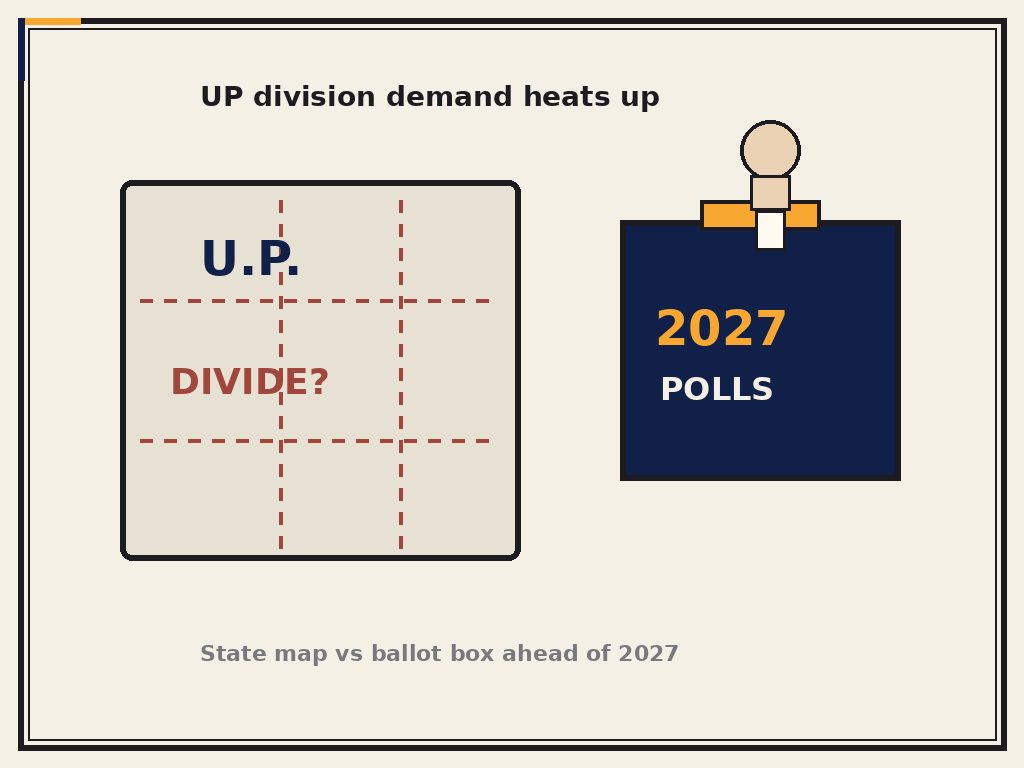
Months before the 2027 assembly polls, the long-dormant debate surrounding Uttar Pradesh division has suddenly returned to the political center stage in Lucknow. NDA allies are backing the creation of smaller states while actively staking political claims to leadership within those proposed regions. The latest revival was sparked when Suheldev Bharatiya Samaj Party (SBSP) president and panchayati raj minister Om Prakash Rajbhar claimed that the state would eventually be carved into four distinct regions—Purvanchal, Madhyanchal, Bundelkhand, and Harit Pradesh.
Rajbhar went further, asserting that the BJP’s central leadership had assured him the state partition would occur following the caste census. While this proposal surfaces reliably before every major electoral cycle, it has largely remained dormant since 2011. That was the year Mayawati’s Bahujan Samaj Party government formally passed a resolution in the assembly advocating for a four-way state split.
Constitutional Realities and Political Posturing
For residents of Lucknow and across the state, debates of this magnitude carry immense administrative and emotional weight. Under Article 3 of the Indian Constitution, creating new states ultimately requires formal parliamentary legislation rather than simple executive or state-level resolutions. Yet, political actors continue to leverage the territorial division narrative to rally regional aspirations. As parties prepare their ground troops, discussions about administrative efficiency clash directly with concerns over resource distribution and regional identity.
The political maneuvering is already reshaping alliances across the state. Leaders are positioning themselves to capture local vote banks, keeping strategists busy as organizations draft campaigns. Observers following the developments closely note that similar debates often overshadow everyday civic governance issues in the capital, shifting public focus from urban infrastructure to identity politics.
Why It Matters
For anyone living in Lucknow, students navigating career prospects, or locals keeping a close eye on home affairs, a potential state bifurcation changes the administrative landscape entirely. Splitting a mammoth state like Uttar Pradesh alters capital economies, state-level resource allocations, and bureaucratic jurisdictions. Whether this renewed debate translates into actual legislative action or remains a strategic electoral ploy will dictate how political parties campaign in the upcoming months.
- Administrative oversight in Lucknow could shift drastically if Madhyanchal is established as a separate administrative unit.
- Regional parties are using the state split narrative to consolidate specific caste and community bases ahead of voting.
- Voters must weigh long-term administrative feasibility against emotional appeals tied to regional development.
The ongoing debate over state reorganization serves as a high-stakes electoral chess piece, forcing voters to look past immediate campaign slogans and examine the long-term structural future of the region.
Navigating the 2027 Political Landscape
As political momentum builds up to the elections, local stakeholders are tracking every shift in alliance dynamics. For instance, discussions regarding administrative decentralization run parallel to intense party preparations, such as those seen in BL Santhosh Lucknow meetings begin as BJP prepares ground for 2027 Uttar Pradesh polls and broader strategy rollouts like the BJP 2027 polls roadmap: Core group plans Seva Sankalp blitz in Lucknow. Meanwhile, opposition forces are countering with their own statewide mobilizations, echoing patterns seen when the Samajwadi PDA Yatra Bus Reaches Lucknow as SP Locks 2024 Slogan for 2027 Polls.
Minister Rajbhar’s assertions have also drawn parallels to previous discussions, building on what was previously analyzed regarding the UP Division Demand: Cabinet Minister Om Prakash Rajbhar Calls State Split Into Four Inevitable. As parties refine their messaging, leaders from across the political spectrum continue to weigh in on how regional restructuring might affect governance. For more context on how various factions are aligning their strategies in the capital, review updates on the Sanjay Nishad Protest in Lucknow Clarifies Alliance Stand Ahead of 2027 Polls, or examine broader electoral predictions such as those detailed regarding BJP UP Elections: Nitin Nabin Predicts Massive Majority in 2027. Opposition pushes by figures like Asaduddin Owaisi Uttar Pradesh Rallies Set Up High-Stakes Electoral Battle Ahead of 2027 further complicate the multi-cornered contest.
Detailed reports on the resurgence of this debate can be read directly at Hindustan Times.