
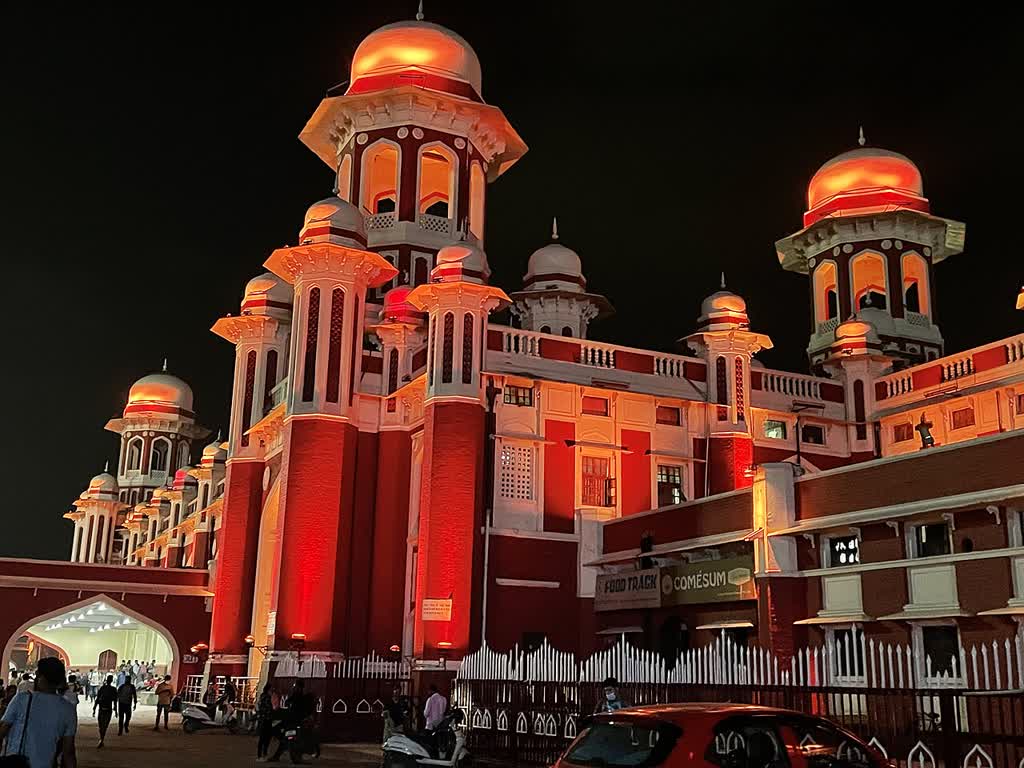
Charbagh Railway Station
If you arrive in Lucknow by the Northern Railway, the first palace you see is not a palace. It is Charbagh. Red and cream, domes and chhatris, a garden in front, trains behind. Locals still pause on the forecourt for a photograph they have taken a hundred times. It is a working station, code LKO, not a ticketed monument. You may look at the facade. You need a railway ticket to go onto the platforms.
History
Lucknow was already a major railway town in the nineteenth century, headquarters of the Oudh and Rohilkhand Railway, whose Lucknow-Kanpur line opened in 1867. The present main building is later. Bishop George Herbert laid the foundation stone in March 1914. J.H. Horniman designed it, with consulting engineer Chaubey Mukta Prasad. The mix is Indo-Saracenic as Lucknow likes it: Mughal, Awadhi and Rajput notes on a British railway plan. The building was completed in 1923 and opened to the public in 1926. Period cost is usually given as about Rs 70 lakh.
Charbagh means four gardens, the old Persian-Mughal layout, and there is still a garden before the facade. Aerial photographs make the roof look like a chessboard of domes and turrets; that is a visitor’s observation, not an architect’s manifesto. The station is Northern Railway, Lucknow NR division headquarters, NSG-2, with nine platforms on the LKO side. Next door, in the same complex but a different zone, sits Lucknow Junction, LJN, of North Eastern Railway. Drivers who say “Charbagh” may mean either building. Ask which train.
As of 2026 the station is in the middle of an Amrit Bharat redevelopment, a large concourse and extra platforms among other works, with heritage look meant to be kept. Scaffolding, dust and diverted gates are part of the current visit. The facade is still the thing you came to see; it may be partly screened. Come back for the garden view when the boards say the front is clear.
What to see
Stand on the forecourt and look up. Domes, mini-minarets, arches, the long palatial front, the garden. That is the public monument. An old steam engine has often been shown near an exit; whether it is in the same spot after the works is a day-of question. Do not wander into offices or parcel yards. Do not treat the platforms as a museum aisle. If you want a train, buy a ticket. If you want only the building, the outside is enough, and it is free.
Metro Red Line has a Charbagh station beside the railway. Alambagh and the long-distance bus stands sit in the same southern belt. From here the city opens north toward Hazratganj and the old monuments. This is a gateway, not a half-day ruin.
Visiting
There is no monument ticket and no ASI hour. Indian Railways runs the place around the clock because trains do. The forecourt is public in the ordinary way a station approach is public: watch your bag, ignore anyone selling a “station tour,” and do not block the porch. Platforms require a valid journey ticket or platform ticket from the counters. Photography of the facade from the garden is a local habit; security can still object to tripods and drones. Ask, then shoot.
Charbagh is the usual rail arrival for visitors heading to Bara Imambara, the Residency, or the Ganj. Autos, app cabs and the Metro cover the next hop. If your train is NER, you may be at LJN, a short walk and a different entrance. Construction under the 2026 redevelopment can move those walks. Follow the yellow signs, not last year’s blog map.
Nearby
North toward the Gomti you reach Hazratganj, Begum Hazrat Mahal Park, and Lucknow Zoo at Banarasi Bagh. The British Residency is a separate auto ride into Qaiserbagh. Dilkusha Kothi sits east, on the old 1857 line of march, if you are collecting ruins rather than trains. More of the city is gathered under Lucknow places.
If you have a long wait between trains, the garden and the facade are the honest use of that hour. The Imambaras, the Residency and the Ganj are not a ten-minute stroll from the porch, whatever a tout says. Take the Metro or an auto when you are ready to leave the rails behind.
Give the facade five still minutes before you join the queue at the auto stand. Lucknow’s station is allowed to look like this. Take the look.
\n\n
FAQs
What is Charbagh Railway Station and why visit?
If you arrive in Lucknow by the Northern Railway, the first palace you see is not a palace.
What can visitors do there?
Stand on the forecourt and look up. Domes, mini-minarets, arches, the long palatial front, the garden.
What are the timings or entry arrangements?
There is no monument ticket and no ASI hour.
How do I reach it and what should I know before going?
Charbagh is the usual rail arrival for visitors heading to Bara Imambara , the Residency, or the Ganj.
How long should I spend and what can I pair nearby?
North toward the Gomti you reach Hazratganj, Begum Hazrat Mahal Park , and Lucknow Zoo at Banarasi Bagh.