
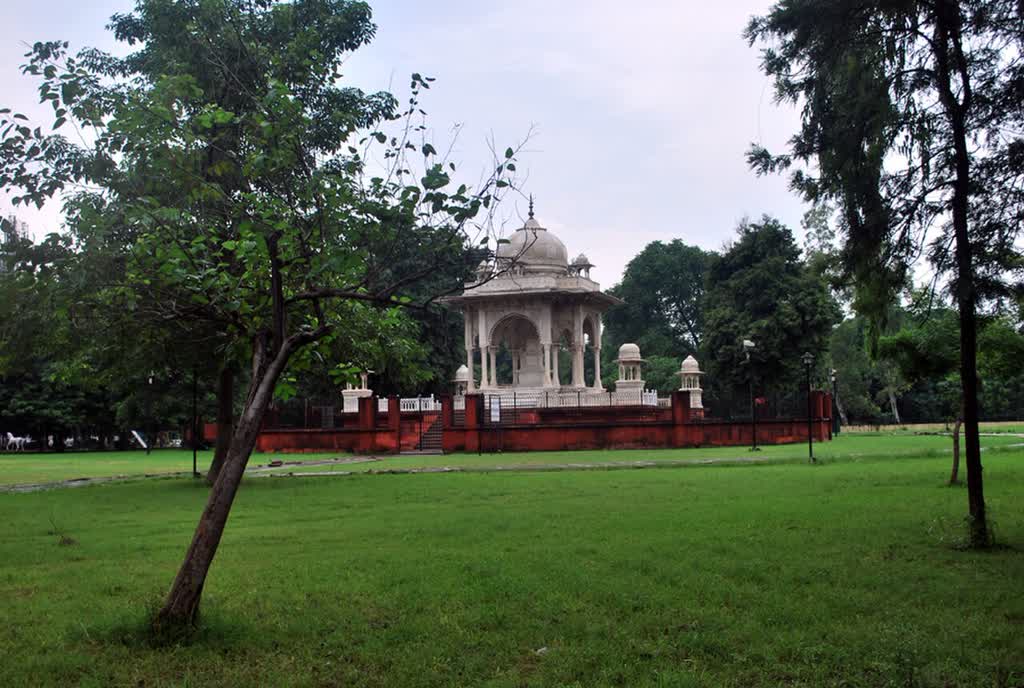
Begum Hazrat Mahal Park
On the Qaiserbagh side of the Ganj, behind a modest gate, a lawn opens around a marble memorial. Lucknowis say Begum Hazrat Mahal Park. It is an LDA city park with a queen at the centre, not a palace and not a ticketed monument of the Trust. Morning walkers, office-goers on a cut-through, and families at dusk use it the way Hazratganj uses shade: often, and without a speech.
History
Begum Hazrat Mahal, born Muhammadi Khanum around 1820 in Faizabad, was a junior wife of Wajid Ali Shah. After the British exiled the Nawab to Calcutta in 1856, she stayed in Lucknow. In 1857 she made their son Birjis Qadr wali of Awadh and served as regent. When Lucknow fell she withdrew, eventually to Nepal, and died in Kathmandu in 1879. India remembers her as one of the uprising’s leaders. On 15 August 1962 the old Victoria Park in this pocket of Hazratganj was renamed for her, and a marble memorial was raised.
The memorial carries the Awadh coat of arms on brass plaques. It is a civic honour, not her grave; she lies near Kathmandu’s Jama Masjid. The park has hosted Ramlila, Dussehra bonfires and Lucknow Mahotsava over the years. A 1984 commemorative stamp and a later national scholarship in her name keep the memory in print. Some tourism pages invent a museum of 1857 arms inside the park. Walk the ground: what you will reliably find is lawn, trees, the marble, and whatever fountain or play corner LDA has working that season.
What to see
The marble memorial is the reason the park has a proper name. Walk up to it. Read the plaques. Then use the place as Lucknow uses it: a circuit under the trees, a bench, children on the play equipment when it is open, and the Ganj a few minutes away when you want noise again. Evening lights and fountains are a local habit here, not a guaranteed show; if the jets are dry, the lawn still does the job. This is not Ambedkar Memorial Park and it is not Lohia Park. Those are Gomti Nagar scales. This is a central-city pocket with a queen in the middle.
The park is also a civic stage. Ramlila and seasonal fairs have used this ground because it sits in the heart of the Ganj, not because it is a battlefield museum. If you came looking for muskets under glass, you will be disappointed, and that is honest. The marble and the name are the memorial. The rest is a city lawn that Lucknow actually uses.
Keep the memorial free of climbing and of reel-making that treats her as a backdrop. The 1857 story sits better if you pair this park with the British Residency and with Shah Najaf Imambara, both a short ride, both closer to the fighting than this lawn.
Visiting
Lucknow Development Authority runs the park. Hindustan reported on 9 October 2024 that LDA had raised the gate ticket here and at Lohia Park from Rs 10 to Rs 15, with monthly passes to Rs 150 and annual passes to Rs 1,500, and with free entry still listed for visitors over 60 and children under 12. That is the most recent LDA-linked tariff we could read. Boards change. Pay what the window shows. Commercial pages often print 6 am to 9 pm; we did not find a live LDA clock on 28 August 2026. Confirm hours at the gate you use.
Hazratganj Metro is the obvious station. The park sits off Rani Lakshmibai Marg / the Qaiserbagh-Ganj edge; drivers know “Begum Hazrat Mahal Park.” It is open all week in ordinary times. After rain the lawn can be wet and the Ganj traffic slower. Morning walkers sometimes catch an early slot; whether that hour is still free is a board question, not a promise from an old blog.
Nearby
Hazratganj is the boulevard this park belongs to. The Residency and Qaiserbagh ruins are the 1857 walk. Shah Najaf and Sikandar Bagh continue that geography toward the Gomti. Banarasi Bagh holds Lucknow Zoo and the State Museum. Chattar Manzil is the riverside palace in the same historic belt, seen from outside. For a wider list, see Lucknow places.
Come for the name, stay for the shade, and leave the Ganj noise at the gate for twenty minutes.
\n\n
FAQs
What is Begum Hazrat Mahal Park and why visit?
It is the Kaiserbagh memorial park dedicated to Begum Hazrat Mahal, a green pause among Nawabi remnants rather than a ticketed palace tour.
What can visitors do there?
Walk the lawns and memorial setting, photograph the white and garden edges, and use it as a calm hinge between Safed Baradari and the Residency.
What are the timings or entry arrangements?
Treat it as a public park with local opening habits; confirm any gate board on the day. There is no Imambara-style ticket desk.
How do I reach it and what should I know before going?
Autos know Begum Hazrat Mahal Park / Kaiserbagh. Wear walking shoes; wedding traffic near Safed Baradari can slow the last stretch.
How long should I spend and what can I pair nearby?
Thirty to sixty minutes. Pair with Safed Baradari, the Residency, or a later Hazratganj walk.