
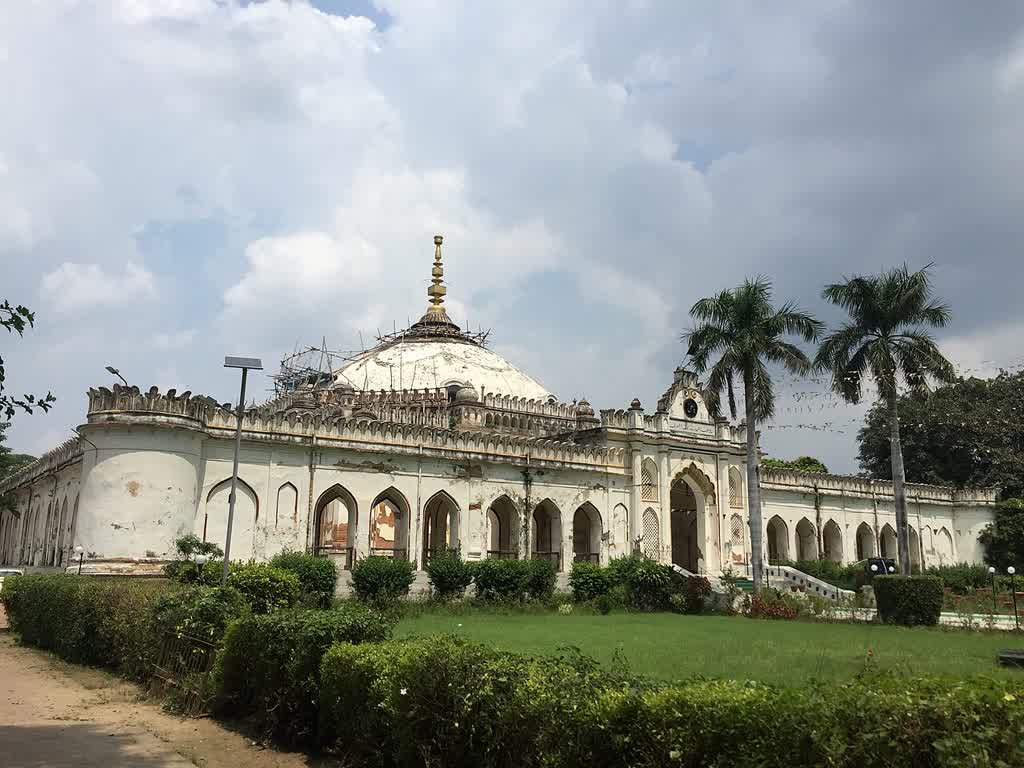
Shah Najaf Imambara
On Rana Pratap Marg, a short walk from the Ganj and almost on the Gomti, a white-domed hall sits behind a quiet court. Lucknowis call it Shah Najaf. It is the tomb Ghazi-ud-Din Haider built for himself, named for Najaf in Iraq, and it is still a living imambara. People come for ziyarat, for Muharram, and for an hour that feels slower than Hussainabad. It is not Bara Imambara and it is not Chota Imambara. Those two halls belong to a different Nawabi programme, west of the old city. This one belongs to the first King of Awadh, and it sits among Hazratganj trees.
History
Ghazi-ud-Din Haider ruled Awadh from 1814 to 1827. He was the last Nawab Wazir and the first to take the title of King, after the East India Company recast the old wazirate. He raised this imambara in honour of Ali, whom Shia devotion names Shah-e-Najaf, the lord of Najaf. The building is meant to recall Ali’s shrine at Najaf-e-Ashraf. Dates in standard accounts cluster in the later 1810s; Wikipedia gives construction in 1818 and completion in 1823. Some older city notes print 1816-17. What is not in dispute is the purpose. He wanted to lie here.
He does. The main hall holds his grave, and those of three wives: Mubarak Mahal, Sarfaraz Mahal and Mumtaz Mahal. A mosque and, once, a riverside house for Mumtaz Mahal stood in the compound. City accounts say the house was pulled down in 1913 when a road was cut along the Gomti. The imambara remained. In November 1857, after the storming of nearby Sikandar Bagh, Sir Colin Campbell’s column came this way to relieve the British Residency. Period writing describes Shah Najaf as a walled mosque that took heavy fire from the British naval brigade. The thick walls, the story goes, held.
Do not fold this hall into the Hussainabad Trust loop. The Husainabad and Allied Trust looks after Bara Imambara, Chota Imambara, Satkhanda and the Picture Gallery. Shah Najaf is a separate shrine on the Hazratganj-Gomti side of town. Guides who sell you “all the imambaras” in one ticket are mixing two geographies.
What to see
The dome is the first thing you notice: a large, rather simple cupola, without the slender drum that marks so many Lucknow onions. The court in front is modest. Inside, the hall is a tomb and an azakhana, hung for mourning when the lunar calendar asks for it. Give time to the graves rather than circling them for a photograph. The mosque in the compound is still used; shoes come off, shoulders are covered, and voices drop. On the 13th of Rajab, Ali’s birthday in the Shia calendar, the building is dressed and lit. Muharram fills it again.
There is less spectacle here than at Hussainabad, and that is the point. You will not find a maze, a clock tower, or a tank of the size you see at Chota Imambara. What you get is a working shrine with a clear royal burial. If you want Nawabi portraits after this, that is a different ride, to the Hussainabad Picture Gallery.
Visiting
Shah Najaf is not on the Trust combined pass fetched from lucknowimambara.com in August 2026. Commercial pages commonly list it as free, with visitor hours printed as 8 am to 5 pm, sometimes starting at 6 am. None of those clocks sat on an official Trust or ASI tariff board we could read. Treat them as a guide. Confirm at the gate, especially on Friday and in Muharram, when prayer and mourning can close or slow the court.
Dress as you would for a mosque. Footwear comes off in the prayer spaces. Do not treat the graves as a prop. Professional shoots need permission, not a smile at the watchman. From Charbagh, an auto up through Hazratganj is the usual hop. Metro riders alight at Hazratganj and continue a few minutes by e-rickshaw along Rana Pratap Marg. Pair the visit with a Ganj walk, not with a rushed Imambara circuit across town.
Nearby
Next door in spirit, and almost next door on the map, is Sikandar Bagh, now largely the CSIR-NBRI botanic garden. Hazratganj is a short stroll: shops, shade, and a cold drink after the dome. Begum Hazrat Mahal Park sits on the Qaiserbagh side of the Ganj. Banarasi Bagh holds Lucknow Zoo and the State Museum if you want a longer afternoon. The Residency is the 1857 companion to the walls that took the naval guns here. For a wider list, see Lucknow places.
Come in winter light if you can. Come in Muharram only if you are ready to stand aside for the majlis. This is a tomb first.
\n\n
FAQs
What is Shah Najaf Imambara and why visit?
On Rana Pratap Marg, a short walk from the Ganj and almost on the Gomti, a white-domed hall sits behind a quiet court.
What can visitors do there?
The dome is the first thing you notice: a large, rather simple cupola, without the slender drum that marks so many Lucknow onions.
What are the timings or entry arrangements?
Shah Najaf is not on the Trust combined pass fetched from lucknowimambara.com in August 2026.
How do I reach it and what should I know before going?
Dress as you would for a mosque. Footwear comes off in the prayer spaces.
How long should I spend and what can I pair nearby?
Next door in spirit, and almost next door on the map, is Sikandar Bagh, now largely the CSIR-NBRI botanic garden.