
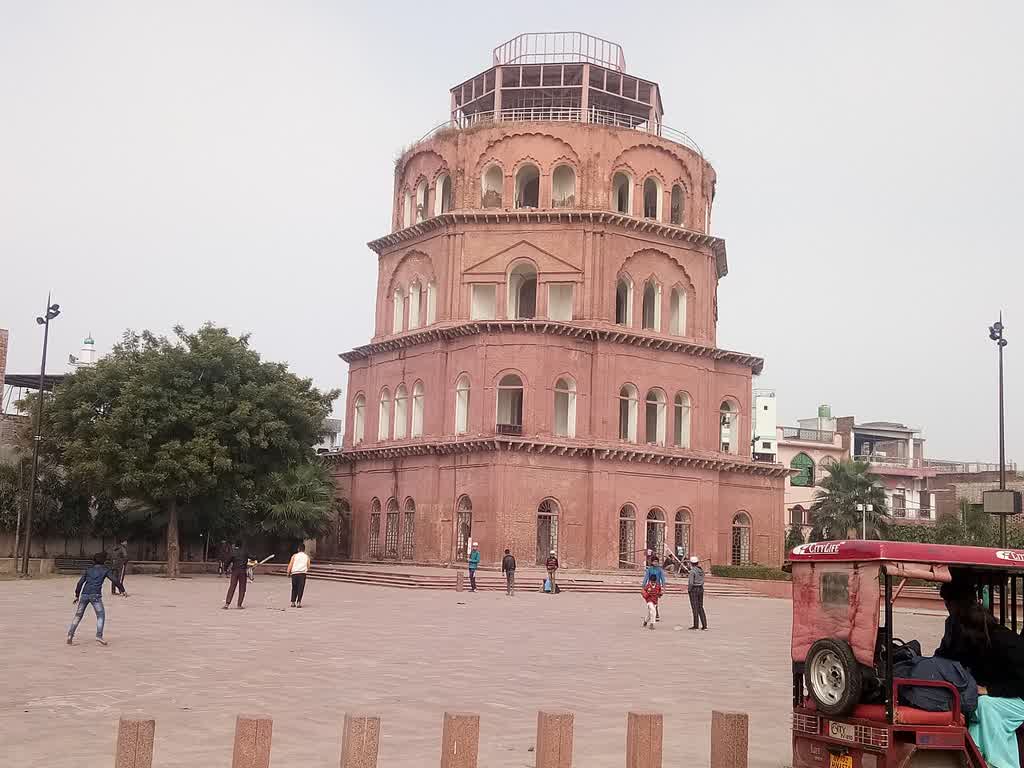
Satkhanda
On the Hussainabad ground, a little apart from the gilt of Chota Imambara, a square brick tower stops in mid-air. Lucknowis call it Satkhanda, seven storeys, though only four were ever built. Muhammad Ali Shah meant a watchtower and a place from which the moon might be sighted. He died, and the work died with him. You come for that unfinished silhouette, and for the way it sits among neighbours that did get finished.
History
Nawab Muhammad Ali Shah ruled Awadh from 1837 to 1842. In those five years he laid out Hussainabad as a ceremonial quarter: an imambara for himself, a mosque, tanks, and this tower. Satkhanda means seven-storeyed. Construction reached four. Standard accounts say the halt followed his death; later rulers did not take the work up again. The tower is brick, with large triple-arched openings and a spiral stair. Height figures in local notes run around twenty-one metres. Treat that as a published estimate, not a measured survey you can quote at dinner.
Older copy on this site, and plenty of tourist pages, folded Satkhanda into Chota Imambara as if it were a room of that hall. It is not. Chota Imambara is the Hussainabad Imambara, the Palace of Lights, Muhammad Ali Shah’s own tomb. Satkhanda stands nearby on the Hussainabad maidan. Rumi Darwaza is older still, an Asaf-ud-Daula city gate. You walk through it to reach this ground. You do not enter Satkhanda through it.
Talk of the Leaning Tower of Pisa is a guidebook comparison, not a documented brief. Talk of a daughter’s death as the reason the tower stopped is a local story; historians have pushed back on the ankle-injury legend. What the Trust still sells is simpler: an unfinished Nawabi watchtower, ticketed with the rest of the Hussainabad cluster.
What to see
Stand back first. The pleasure of Satkhanda is the stump against the sky, the arched windows stacked four high, and the way evening floodlights pick the brick. Hussainabad Clock Tower is the Victorian neighbour, taller, Gothic, and not Nawabi. Do not confuse the two. The clock is 1881 and Trust-built from the endowment; this tower is Muhammad Ali Shah’s own reign.
Whether you may climb on a typical day is a gate question. The Husainabad and Allied Trust lists Satkhanda as a separate monument on its pass table, which implies a managed visit, not a street ruin you simply walk into. Local reporting in late 2025 spoke of the tower being prepared and opened more fully for visitors after conservation work. Stairs, railings and last-entry rules change with that work. Ask at the Trust counter before you assume a roof view. Do not pay a freelance “guide” for a climb the Trust has not posted.
After the tower, the indoor half of this stop is the Picture Gallery in the old baradari, where oil portraits of the Nawabs hang in a long hall. Chota Imambara is the gilt hall across the ground. Bara Imambara is a short walk east, through Rumi Darwaza.
Visiting
In August 2026 the Trust portal lucknowimambara.com listed hours as 6 am to 6 pm, with a Satkhanda-only Indian adult pass at Rs 20 (child Rs 10; foreign adult Rs 200) and a combined pass covering Bara Imambara, Chota Imambara, Satkhanda and the Picture Gallery at Rs 60 for an Indian adult. The same table listed Bara Imambara as closed on Fridays from 10 am to 3 pm for prayers. Other Hussainabad halls were described as open sunrise to sunset. Rates change. Buy at the counter or on the Trust site and confirm the day’s hours, and whether the stair is open, at the gate.
Hussainabad is west of Hazratganj, a few kilometres from Charbagh. Autos from Kaiserbagh, Chowk and Hazratganj Metro are the usual last hop; the Red Line does not stop at the Imambara gates. Pair Satkhanda with the two Imambaras and the Picture Gallery on one morning so you are not buying four stories of the same ticket. Winter evenings are kind on the brick. Chowk is close for kebabs when you come out.
Nearby
Rumi Darwaza, Chota Imambara, the Clock Tower and the Picture Gallery share this open ground. Teele Wali Masjid is in the same old-city pocket. If you still have an afternoon, the British Residency in Qaiserbagh is a change of register: ruins instead of arched brick. More of the city’s map sits under Lucknow places.
Give the tower ten unhurried minutes. It is easy to under-see if you only shoot it from a moving auto on the way to Chota Imambara.
\n\n
FAQs
What is Satkhanda and why visit?
On the Hussainabad ground, a little apart from the gilt of Chota Imambara, a square brick tower stops in mid-air.
What can visitors do there?
Stand back first. The pleasure of Satkhanda is the stump against the sky, the arched windows stacked four high, and the way evening floodlights pick the brick.
What are the timings or entry arrangements?
In August 2026 the Trust portal lucknowimambara.com listed hours as 6 am to 6 pm, with a Satkhanda-only Indian adult pass at Rs 20 (child Rs 10; foreign adult Rs 200) and a combined pass covering Bara Imambara, Chota Imambara, Satkhanda and the Picture Gallery at Rs 60 for an Indian adult.
How do I reach it and what should I know before going?
Hussainabad is west of Hazratganj, a few kilometres from Charbagh.
How long should I spend and what can I pair nearby?
Rumi Darwaza, Chota Imambara, the Clock Tower and the Picture Gallery share this open ground.