
Hussainabad Picture Gallery
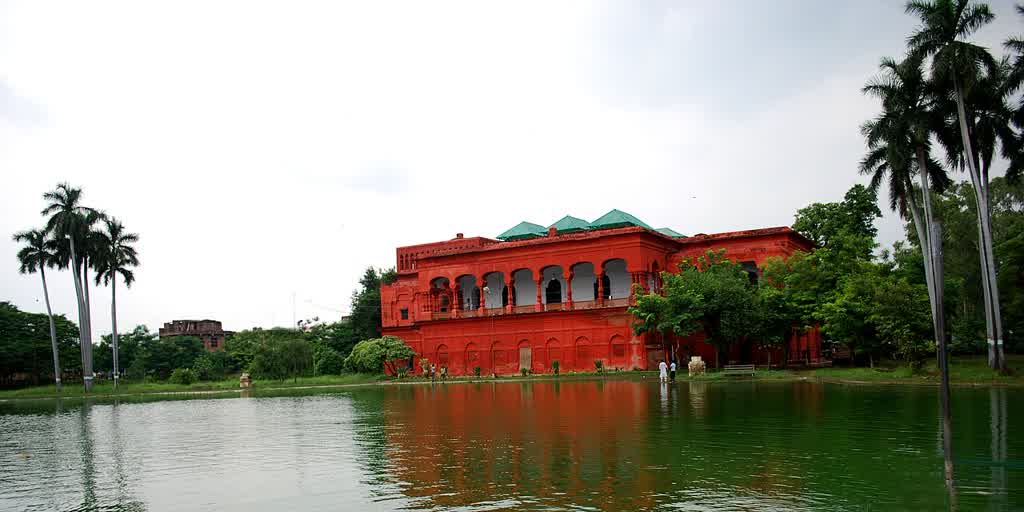
Beside the Clock Tower on the Hussainabad maidan, a long baradari holds a cool hall of oil portraits. Lucknowis call it the Picture Gallery. The Trust calls it that too. It is not a room of Chota Imambara, and it is not the Bhulbhulaiya. The maze sits above the great hall of Bara Imambara. This gallery is a separate ticketed hall in Muhammad Ali Shah’s old summer pavilion, where the Nawabs still look down from the walls.
History
The building began as a baradari, a twelve-doorway pavilion, raised around 1838 in the same Hussainabad programme that produced Chota Imambara and Satkhanda. Muhammad Ali Shah used it as a summer house. A tank was dug in front about a year later. Period notes mention a small mosque and a hammam at the corners of that tank, a sarai and Meena Bazaar in front, and stables for elephants and horses nearby. The Trust’s own page still tells that layered story: the gallery occupies only part of a larger Nawabi complex.
The portraits came later. Standard accounts say life-size pictures of the Nawabs of Awadh were painted between 1882 and 1885 by visiting European artists, names often given as Dawling, Gravet and Harrison, with an Indian painter, D.S. Singh, also credited. British-era officials join the Nawabs on the walls. Talk of elephant-skin canvases and eyes that follow you is older gallery colour; look at the paint, then decide how much of that talk you need. What you can say without embroidery is simpler: this is still one of the easiest places in Lucknow to see how the court dressed itself.
Do not look for it inside the Bhulbhulaiya. Some tourist pages still print “Bhool Bhulaiya Picture Gallery,” mixing the maze with this baradari. The maze is brick passages over Bara Imambara. The gallery is this terracotta pavilion by the Clock Tower.
What to see
You climb a flight of steps into the main hall. Full-length Nawabs hang in a row, jewellery, shoes and all. Walk slowly. The pleasure is costume and face, not a treasure hunt. Upper-storey iron pillars are often pointed out as an early use of iron in a Nawabi building; treat that as a local architectural note, not a laboratory finding. The tank in front, when it holds water, gives the baradari a second face. The Clock Tower fills the sky beside you. Satkhanda is the unfinished brick neighbour. Rumi Darwaza leads back toward Bara Imambara.
Give this hall half an hour. It is the indoor half of the Hussainabad maidan, and it explains who paid for the endowment that later paid for the Victorian clock outside. If the shutters are down, you have lost that half; confirm opening with the Trust counter before you cross the ground in the heat.
Visiting
The Husainabad and Allied Trust listed, in August 2026 on lucknowimambara.com, a Picture Gallery Indian adult pass at Rs 20 (child Rs 10; foreign adult Rs 200) and a combined pass at Rs 60 covering Bara Imambara, Chota Imambara, Satkhanda and this gallery. Hours on that portal were 6 am to 6 pm. The Trust FAQ named a Friday 10 am to 3 pm closure only for Bara Imambara. Older tourism pages still print the gallery as closed on Friday, or as opening at 10 am. Those two clocks cannot both be right on every day. Confirm at the pass window. Footwear rules follow the hall; photography rules are posted and can tighten.
Reach Hussainabad by auto from Hazratganj, Kaiserbagh, Chowk or Charbagh. Metro riders use Hazratganj or KD Singh Babu Stadium, then an e-rickshaw. Buy the combined pass if you are doing the cluster. Winter mornings are kinder on the portraits and on you. Chowk is close when you come out.
Nearby
The Clock Tower, Satkhanda, Chota Imambara and Rumi Darwaza make this the densest heritage stretch in the old city. Bara Imambara is the next hall east. If you want a larger museum after court portraits, the Lucknow State Museum at Banarasi Bagh holds the city’s bigger archaeology and painting collection. The British Residency is the 1857 register if you ride toward Qaiserbagh. More walks sit under Lucknow places.
Stand in the doorway a minute before you leave. The Nawabs on the wall and the clock outside belong to two different Lucknows, paid for, in a roundabout way, by the same endowment.
\n\n
FAQs
What is Hussainabad Picture Gallery and why visit?
Beside the Clock Tower on the Hussainabad maidan, a long baradari holds a cool hall of oil portraits.
What can visitors do there?
You climb a flight of steps into the main hall.
What are the timings or entry arrangements?
The Husainabad and Allied Trust listed, in August 2026 on lucknowimambara.com, a Picture Gallery Indian adult pass at Rs 20 (child Rs 10; foreign adult Rs 200) and a combined pass at Rs 60 covering Bara Imambara, Chota Imambara, Satkhanda and this gallery.
How do I reach it and what should I know before going?
Reach Hussainabad by auto from Hazratganj, Kaiserbagh, Chowk or Charbagh.
How long should I spend and what can I pair nearby?
The Clock Tower, Satkhanda, Chota Imambara and Rumi Darwaza make this the densest heritage stretch in the old city.